Nils Müller · 29 September 2026
Material Selection Criteria for Beams Deployed in High-Wind Desert Construction Zones
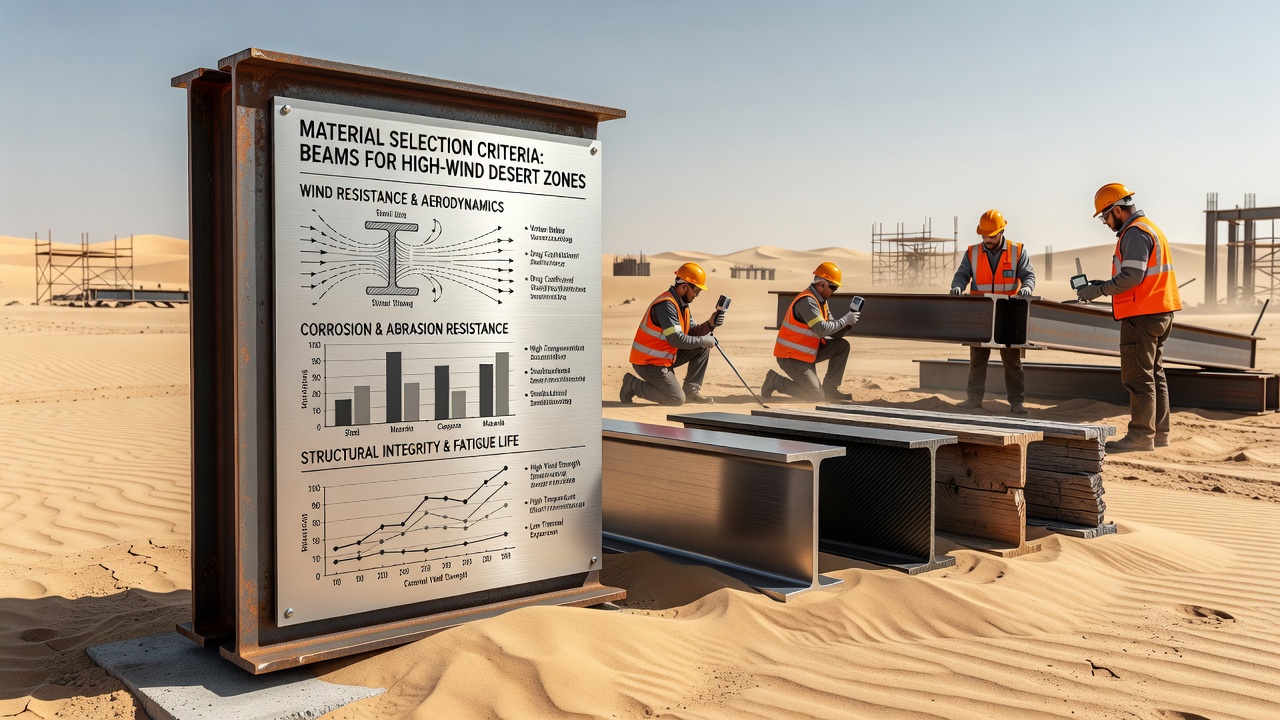
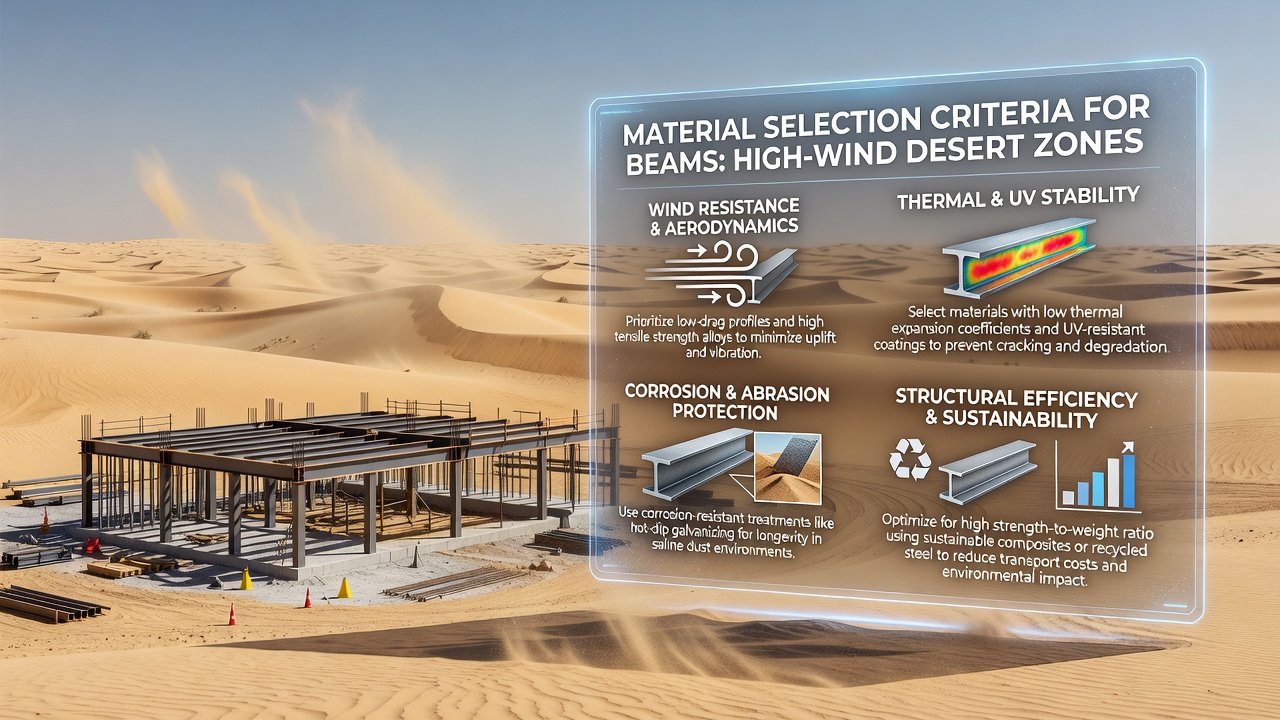
High-wind desert construction zones present distinct challenges for beam materials because sustained gusts often exceed 80 kilometers per hour while airborne sand particles create continuous surface abrasion and extreme diurnal temperature swings accelerate thermal fatigue. Engineers evaluate candidates by matching documented performance data against measured site conditions such as peak wind velocity, sand particle size distribution, and annual temperature range. Research from arid-zone monitoring stations shows that wind-driven sand can remove protective coatings at rates up to 0.2 millimeters per year on untreated steel surfaces, while ultraviolet exposure simultaneously degrades polymer-based finishes. Selection therefore begins with quantification of these combined stressors rather than isolated properties.
Environmental Load Factors in Arid High-Wind Regions
Wind load calculations follow established codes that incorporate terrain roughness length values typical of open desert landscapes, where sparse vegetation allows higher velocity profiles near ground level. Temperature cycling between daytime highs above 45 degrees Celsius and nighttime lows below 10 degrees Celsius induces repeated expansion and contraction cycles that promote micro-crack formation in rigid materials. Low humidity accelerates corrosion once any protective layer is breached, and occasional flash-flood events introduce brief but intense moisture exposure that can concentrate salts on beam surfaces. Observers note that these factors rarely occur in isolation, so combined-effect testing protocols now appear in updated project specifications scheduled for full implementation by September 2026.
Primary Material Categories and Documented Performance
Structural steel sections remain common because of high yield strength and established fabrication methods, yet they require multi-layer coatings or galvanizing to resist both abrasion and corrosion. Aluminum alloys offer lower density and inherent oxide protection, although their lower modulus demands larger cross-sections to control deflection under sustained wind pressure. Fiber-reinforced polymer composites provide excellent corrosion resistance and reduced weight, while their performance under combined sand impact and ultraviolet radiation depends on resin formulation and fiber orientation. Reinforced concrete beams demonstrate good mass-related damping against vibration, but surface spalling becomes a concern when sand abrasion exposes aggregate and allows moisture ingress during rare precipitation events.
Key Selection Criteria Derived from Field Data
Material stiffness must limit lateral deflection to code-specified ratios under the 50-year return wind event, and fatigue resistance must accommodate millions of gust-induced stress cycles over a 50-year service life. Abrasion resistance is quantified through standardized sand-blast tests that measure mass loss after controlled exposure durations, while thermal expansion coefficients are matched against expected daily temperature swings to minimize connection stresses. Cost data collected across multiple projects indicate that initial material price often constitutes less than 35 percent of total installed cost once maintenance access, coating renewal intervals, and downtime are included. Availability of compatible connection hardware and skilled labor further narrows options in remote desert locations.
Take one documented project in the Mojave region where engineers compared galvanized steel, aluminum, and glass-fiber-reinforced polymer beams under identical wind and sand conditions. The steel option required the thickest coating system to achieve target service life, aluminum sections needed additional stiffeners to meet deflection limits, and the composite beams showed the lowest maintenance projections yet required custom connection details. Data compiled by the Commonwealth Scientific and Industrial Research Organisation on similar Australian arid-zone installations confirm that coating integrity remains the dominant predictor of long-term performance across metallic options.
Standards, Testing Protocols, and Regional Guidelines
Designers reference wind speed maps and terrain categories contained in ASCE 7 and comparable international documents, while abrasion testing follows procedures outlined in ASTM G76 and ISO 7784. Thermal cycling protocols now incorporate extended dwell times at peak and trough temperatures to replicate desert diurnal patterns. A 2024 industry report prepared by the National Research Council Canada examined beam performance in high-wind prairie and semi-arid zones, revealing that connection detailing often governs overall durability more than base material choice. Updated guidance expected in September 2026 will require explicit documentation of combined wind-plus-abrasion load cases for all beams exceeding 6 meters in span within designated desert wind corridors.
Conclusion
Material selection for beams in high-wind desert zones therefore rests on systematic comparison of measured environmental loads against laboratory and field performance data for each candidate. Engineers integrate wind, abrasion, thermal, and corrosion factors into unified specifications, then verify compliance through standardized testing and regional code requirements. Continued monitoring of installations placed since 2020 will refine these criteria as new coating technologies and composite formulations become available.